
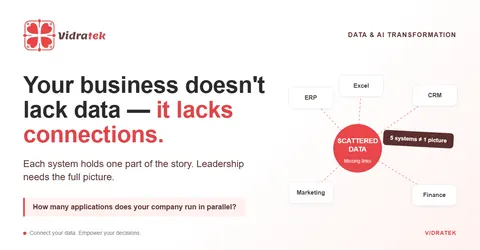
Enterprise data integration means connecting and standardizing data from multiple systems (ERP, CRM, accounting software, marketing platforms and spreadsheets) on one shared platform, so leadership can see the full picture without stitching reports together by hand. Most businesses don't lack data. They lack connections between the data they already have.
Where does business data usually live?
In a typical company, every department uses its own tools:
- Orders live in the ERP.
- Customer information lives in the CRM.
- Costs and cash flow live in the accounting software.
- Leads and campaign performance live on marketing platforms.
- Many other key figures live in Excel, Google Sheets or individual teams' email.
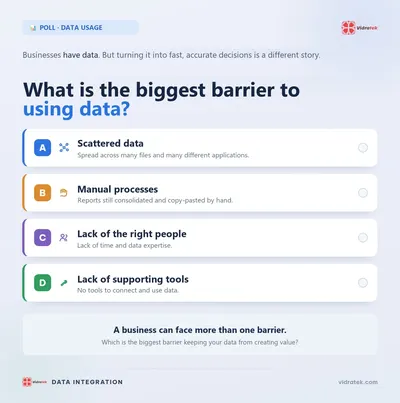
Each system holds one part of the story. No single system shows the whole business.
What problems does scattered data cause in reporting?
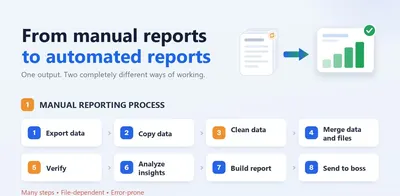
When leadership needs the big picture, teams usually go through these manual steps:
- Export data from several sources.
- Copy and merge Excel files.
- Clean and reconcile the numbers.
- Check whether reports from different departments match.
- Consolidate everything before a decision can be made.
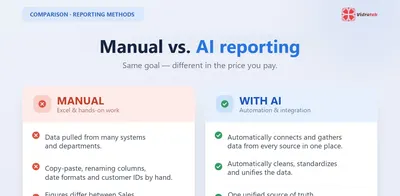
This approach costs more than time. It also leaves numbers prone to error, slow to update and dependent on the people doing the work.
Does your business need to buy more software?
Usually not. The problem is not a shortage of tools. It is that your current systems are not truly connected. Adding new software that cannot connect to your existing systems only creates one more disconnected data source.
Benefits of connected and standardized data
When data from your systems is connected and standardized on one shared platform, your business can:
- See the full picture of operations in one place instead of many separate files.
- Reduce manual reporting time, so people can focus on analysis.
- Spot anomalies earlier thanks to continuously updated numbers.
- Make decisions on consistent data, because every department looks at the same source.
Where should a business start?
Before investing in more tools, answer one question: how many applications does your company run in parallel, and how many of them are actually connected to each other?
A practical way to start is to list the systems you use, identify which data is still exported by hand for reports, and then prioritize connecting the sources that matter most for leadership decisions.
Frequently asked questions about enterprise data integration
What is enterprise data integration?
It is the practice of connecting and standardizing data from multiple systems such as ERP, CRM, accounting software, marketing platforms and Excel files on one shared platform, to create a single set of numbers for reporting and decision-making.
Why do reports from different departments often not match?
Because each department pulls figures from its own system or file, and exporting, merging and reconciling are done by hand. When data is not standardized, the same metric can produce different results.
Do we need to replace our current software to integrate data?
Usually not. The goal is to connect the systems you already have, not to replace them.
How does data integration reduce manual reporting work?
When data is synchronized and standardized automatically, people no longer have to export files, merge spreadsheets and reconcile numbers for every reporting cycle.
Where should a business start with data integration?
List the systems you use, identify which data is still exported by hand, then prioritize connecting the sources that directly support leadership decisions.