
Manual reporting costs money even when the Excel file costs nothing in software. The real cost of manual reporting is consolidation time, checking time, the cost of fixing errors and the cost of slow decisions. Most of it hides inside familiar tasks, so it rarely gets counted.
Where do the hidden costs of manual reporting sit?
The real cost is usually hidden inside very familiar tasks:
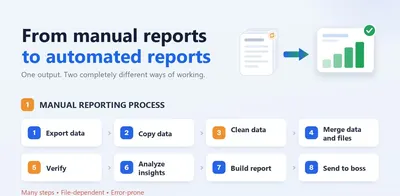
- Contacting each department to extract data.
- Downloading many files from many different systems.
- Copy-pasting data into one summary sheet.
- Fixing column names, date formats and customer IDs.
- Reconciling because Sales, Accounting and Operations show different numbers.
- Redoing the report when the source data has just changed.
For example, a report that takes 5 hours to finish and repeats every week costs about 20 hours a month. If 3 people collect, check and confirm the figures, the cost is no longer 20 hours. It is the combined time of all 3 people. And that is only the part that is easy to see.
What is the time cost of manual reporting?
Skilled staff spend their time downloading files, extracting, cleaning and reconciling data instead of analyzing causes or proposing strategy and action. The more sources a report has, the longer preparation takes, and most of that time creates no extra insight.
What is the cost of errors?
A formula dragged one row short, a file using stale data or a column mapped wrongly is enough to change the final result. The danger is that the report still looks complete until someone notices the numbers don't match.
What is the cost of slow decisions?
If it takes days to consolidate a report, leadership is deciding on a picture of the past. Meanwhile:
- A campaign may keep spending budget without converting.
- A project may keep slipping behind schedule.
- An important customer may not have been followed up.
- A cash-flow problem may only be seen once it has become serious.
What is the cost when the business scales?
A manual process can work when a business has only a few files and a small amount of data. But as customers, transactions, departments and systems grow, so does the volume of copy-pasting. The more a business grows, the more likely reporting becomes:
- Slow.
- Hard to control.
- Dependent on a few people who know how to consolidate the data.
How do you calculate the real cost of manual reporting?
Manual reporting cost = Consolidation time + Checking time + Cost of fixing errors + Cost of slow decisions.
Try applying this formula to a report you produce every week: record each person's hours, how many times it had to be redone and the delay between when the data arises and when leadership receives the report.
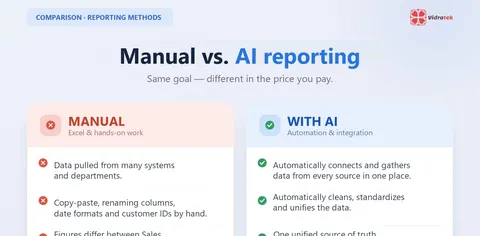
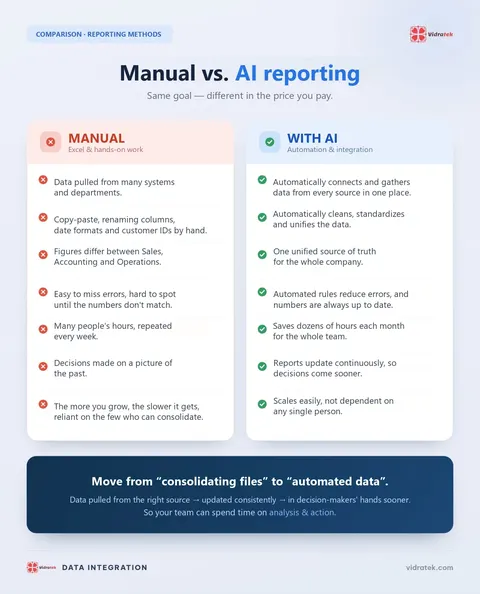
Manual reporting vs AI reporting compared
| Criteria | Manual | With AI |
|---|---|---|
| Data sources | Scattered data pulled from many systems and departments | Automatically connects and gathers data from every source in one place |
| Data handling | Copy-paste, fixing column names, date formats and customer IDs by hand | Automatically cleans, standardizes and unifies the data |
| Consistency | Figures differ between Sales, Accounting and Operations | One unified source of truth for the whole company |
| Errors | Easy to miss errors, hard to spot until the numbers don't match | Automated rules reduce errors and keep numbers up to date |
| Time | Many people's hours, repeated every week | Saves dozens of hours each month for the whole team |
| Decisions | Decisions made on a picture of the past | Reports update continuously, so decisions come sooner |
| Scaling | The more you grow, the more it clogs, reliant on a few people who can consolidate | Scales easily, not dependent on any single person |
What does automating reporting give a business?
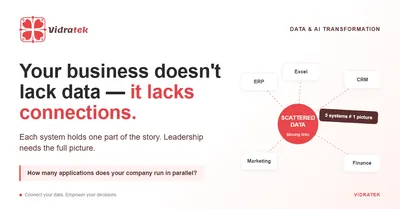
Automating reporting isn't just about making charts look nicer. It helps data come from the right source, stay consistent and reach decision-makers sooner, so the team can spend its time on analysis and action instead of consolidating files. This ties back to data scattered across systems. Read more in Enterprise data integration: you don't lack data, you lack connections.
Frequently asked questions about the cost of manual reporting
What does the real cost of manual reporting include?
Consolidation time, checking time, the cost of fixing errors and the cost of slow decisions.
Is an Excel report really free?
Excel may cost nothing in software, but manual reporting still costs the time of several people, the risk of errors and the price of slower decisions.
Why are manual reports error-prone and hard to check?
One formula missing a row, one file using stale data or one wrongly mapped column changes the result, while the report still looks complete until someone sees the numbers don't match.
What damage do slow decisions cause?
Leadership decides on a picture of the past, so a campaign may keep spending without converting, a project may slip or a cash-flow problem may only be seen when it is serious.
How is automating reporting different from making charts look nicer?
Automation helps data come from the right source, stay consistent and reach decision-makers sooner, rather than only improving how the report looks.