
To keep LMS implementation costs from ballooning, businesses need to lock in the training problem, the first-phase scope, and acceptance criteria before choosing software or requesting quotes. The budget must cover learning content, learner data, integrations, infrastructure, administrator training, and post-launch support. Comparing only plan prices or license fees overlooks the work that usually takes the most effort.
A practical way to start is to pick one process, such as onboarding sales staff, then describe the number of learners, courses, reports, and required integrations. Only after piloting and measuring results should the business decide to expand. This article provides a cost framework, common causes of overruns, and a checklist to help you work clearly with your LMS implementation partner.
What costs are involved in implementing an LMS?
Split the budget into three groups so you don't confuse setup costs with ongoing costs:
- Upfront costs: requirements discovery, course structure design, system configuration, data import, content creation, interface customization, integration, and testing.
- Recurring costs: hosting, bandwidth, backups, updates, security, user support, content management, and plan or license fees if the product you use is paid.
- Variable costs: adding learners, increasing video storage, building new integrations, changing processes, importing more courses, or extending support to more business units.
With Moodle LMS, the open-source software can be downloaded and used without license fees, but self-hosting still requires servers and technical expertise; MoodleCloud is a subscription service; Moodle Workplace is a separately licensed product. See Moodle deployment options and Moodle Workplace details.
What are the seven common reasons LMS budgets run over?
- Unclear requirements: the phrase “full-featured LMS” says nothing about who will use it, for what, or what counts as done.
- Customizing too early: building a custom interface or workflow before trying the built-in features.
- Content not ready: old materials need rewriting, splitting into lessons, quiz creation, or video production; this work is usually not included in the software quote.
- Integrations without specifications: asking to “connect the HRM” without agreeing on the employee ID, what data moves, how often, and how errors are handled.
- Not assessing real-world load: the number of accounts doesn't tell you how many people learn at the same time, video storage needs, or recording requirements.
- No one to run it: nobody updates content, supports instructors, or checks reports after handover.
- Uncontrolled scope changes: new requirements get added mid-project without reviewing the timeline, cost, and impact on work already done.
Each of these can be prevented with a short requirements document, a pilot session with real users, and a clear change approval process.
How do you lock down the first-phase scope before requesting quotes?
Pick one business outcome to improve rather than starting with a list of every feature you could buy. For example: new hires must complete product training and be confirmed by their team lead as ready to advise customers before they take on clients.
The pilot scope can state clearly: one department, two learner roles, two courses, one assessment, one report for managers, and no system integrations if manually importing user lists still lets you test the process. Other needs go on the list for later phases.
To get comparable quotes, send the same requirements brief to every vendor: number of active users, expected concurrent users, devices used, content types, data to import, required reports, security requirements and support responsibilities. Our article on key internal LMS features includes demo scenarios for checking these requirements.
Choose a Moodle deployment option based on your customization needs
If you are considering Moodle, the hosting option directly affects cost and how much work falls on your organization. According to Moodle's support documentation, there are three main paths: self-hosting Moodle LMS, using MoodleCloud, or using a suitable implementation and hosting service.
- Self-hosted Moodle LMS: gives you full control over configuration and integration, but you need to budget for servers, backups, upgrades, security and technical staff.
- MoodleCloud: fast deployment as a managed service; check user limits, storage and the ability to add extensions before choosing. MoodleCloud administrators cannot install arbitrary plugins themselves. See MoodleCloud's plugin policy.
- Implementation services: a good fit when you need process discovery, configuration, integration or support within an agreed scope. Ask clearly which work is covered by the upfront fee and which is billed on a recurring basis.
Don't choose an option just because its starting price is low. Compare total cost for the same number of learners, the same feature requirements and the same operating period.
Learning content and legacy data: two easily overlooked costs
An empty LMS doesn't solve your training problem. Before rollout, inventory which materials are still accurate, who approves content, which courses must be written from scratch and which assessments need to be created. Decide where videos will be stored, who updates them when processes change, and whether past learning records need to be migrated to the new system.
Data import also needs limits: how good is the quality of your employee lists, groups, courses and completion history? If legacy data lacks identifiers or is badly formatted, cleanup time can exceed the LMS configuration work. Migrate only the data needed for the first phase; long-term archival data should have a separate plan.
Moodle supports course backup and restore, but restoring a course does not automatically replace full-system backups and post-migration data testing. See Moodle's backup guide.
HRM, SSO and other integrations: define scope with data
Integrations often get expensive when the requirement stops at “sync with HRM.” Write out a table of the data to be exchanged: employee ID, department, position, employment status, assigned courses and which results must be sent back. For each field, specify the source system, data direction, update frequency, view permissions and how to handle connection interruptions.
For example, does a department transfer automatically change the learning path? When an employee leaves, is their account locked while their training history is kept for reporting? These rules need to be decided before estimating integration work. Moodle offers web services for authorized operations, but actual connectivity depends on the APIs and data rules on both sides. See Moodle's web services documentation.
If integration isn't needed to prove value during the pilot, you can start with a controlled data import process. When scaling up, automate the steps that cause the most errors or take the most time.
Don’t forget infrastructure, video and post-launch support costs
LMS scale isn't just the total number of accounts. Ask how many people log in at peak times, where videos are viewed or stored, whether tests run concurrently and how long data must be retained. These factors affect storage, bandwidth, backups and support arrangements.
If you choose MoodleCloud, active user and storage limits depend on the plan; larger needs may require a different option. See how MoodleCloud calculates plan limits. With self-hosted Moodle, organizations need to estimate infrastructure capacity based on real usage scenarios and run load tests when needed, rather than sizing servers by headcount alone.
In the quote, break out incident response times, support hours, update scope, backup approach and restore testing. If these items are left blank, post-handover operating costs will be hard to predict.
Use acceptance criteria to limit scope creep
Before signing an implementation contract, describe verifiable outputs: a new employee gets an account, receives the correct learning path, completes the assessment, is marked complete according to the criteria, and their manager can view reports within the scope of their permissions. Each requirement should have an approver and sample data.
Break the contract or work plan into milestones: discovery and design; configuration; content and data import; integration if any; testing; admin training; handover and support. At each milestone, state which work is included in the price, the limit on revision rounds and how scope changes are billed.
When a new request comes up, ask three questions before acting on it: what is its impact on the first-phase goal, how do cost and timeline change, and can it be deferred to a later phase? This keeps investment decisions tied to real-world value.
How do you calculate total LMS cost to compare quotes?
To compare options, choose the same time frame, such as 12 or 36 months, then use this formula: total cost = upfront costs + recurring costs over the evaluation period + expected variable costs + contingency for identified risks. You don't need the same contingency figure for every project; it should be based on how clear the requirements are and the data you have.
A minimal estimate sheet should include: line item, quantity, unit price or effort, owner, billing period, assumptions and conditions that would change the price. For example, writing “two courses, each with up to five lessons, content provided by the client” is far clearer than “build learning content.”
When you receive quotes, ask vendors to separate software or hosting from course design, integration and support work. Comparing quotes is only meaningful when they cover the same scope and acceptance criteria.
Measure ROI without looking only at completion rates
Costs are well controlled when the training program solves the problem you chose. Before the pilot, record baselines such as time for new hires to meet requirements, number of repeated instructions, process errors or effort spent compiling reports. After the pilot, review learning progress in the LMS alongside manager feedback and work outcomes.
Course completion does not by itself prove higher productivity. If completion rates are high but work behavior doesn't change, the organization needs to fix the content, the practice exercises or how managers support employees before buying more features. Our article on internal training systems for HR management covers additional metrics you can track.
LMS implementation cost FAQ
Is open-source Moodle LMS completely free?
No. The software has no license fee, but organizations still need to budget for infrastructure or hosting, learning content, implementation, administration and support.
Should a small business implement an LMS on its own?
Possibly, if you have a technical administrator and a tight scope. If you lack operational resources, compare the cost of doing it yourself with a managed service or an implementation partner.
Which features should be deferred to a later phase?
Customizations or integrations that aren’t needed to run the pilot process can be deferred. Keep the mandatory requirements for access, data and reporting needed for the initial goal.
How can I tell if an LMS quote is missing items?
Check the quote against your list of learning content, legacy data, integrations, infrastructure, testing, admin training, post-launch support and acceptance criteria. Ask clearly which parts your organization is expected to handle itself.
Vidratek supports LMS implementation with a clear scope
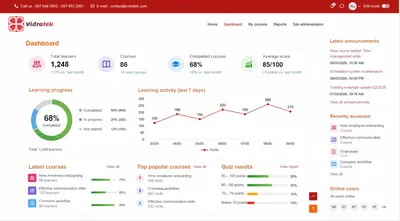
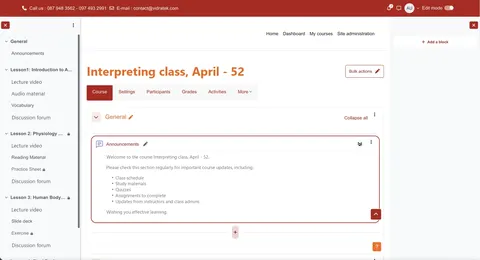
Vidratek helps organizations implement Moodle LMS to manage courses, learners, assessments and reporting. Before configuration, Vidratek works with you to clarify priority processes, input data, mandatory features and who will operate the system after launch. From there, a pilot scope and specific acceptance milestones can be defined. Learn about Vidratek’s LMS services.
Budgeting for an LMS implementation? Share your number of learners, first courses, systems to connect and your three most important reports. Vidratek can review the scope with you and propose an implementation roadmap that fits your current resources. Contact Vidratek.
Back to all posts