
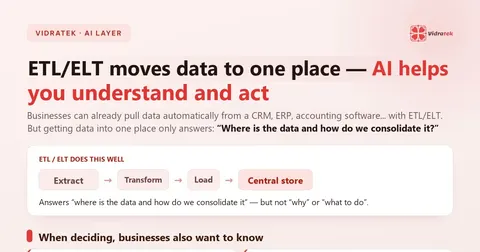
ETL/ELT solves moving data into one place, while an AI Layer helps a business understand its data and act. Businesses can already pull data automatically from a CRM, ERP, accounting software and many other systems with ETL/ELT. But getting data into one place only answers the question “where does the data sit, and how do we consolidate it?”.
What questions has ETL/ELT already answered?
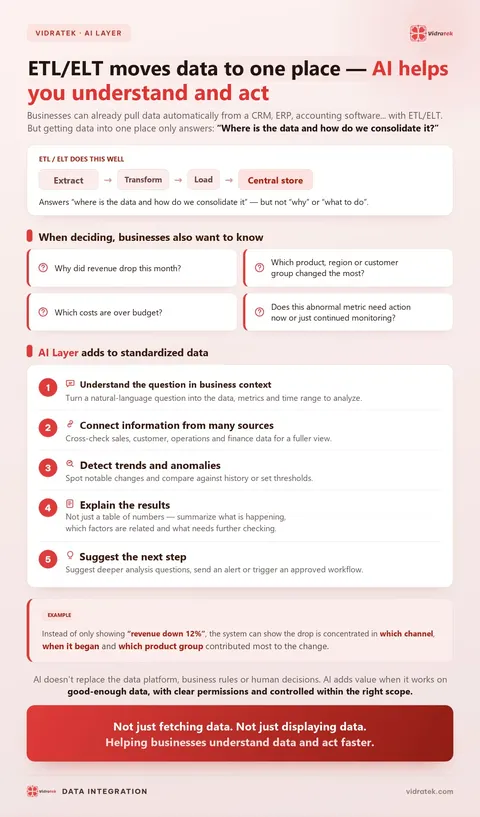
ETL/ELT does a very good job of extracting, transforming and loading data into central storage. It answers “where does the data sit and how do we consolidate it”, but not “why” or “what should we do”.
What else do businesses want to know when deciding?
- Why did revenue drop this month?
- Which product, region or customer group drove the biggest change?
- Which costs are over budget?
- Does this abnormal metric need action now or just continued monitoring?
This is where AI can add to the traditional data workflow.
Which steps does an AI Layer add on top of standardized data?
Step 1: Understand the question in business context
Turn a natural-language question into the data set, metrics and time range to analyze.
Step 2: Connect information from multiple sources
Cross-check sales, customer, operations and finance data to build a fuller view.
Step 3: Detect trends and anomalies
Spot notable changes and compare them against history or thresholds you have set.
Step 4: Explain the results
Don't just return a table of numbers. Summarize what is happening, which factors are related and what needs further checking.
Step 5: Suggest the next step
Suggest deeper analysis questions, send an alert or trigger a workflow the business has approved.
Example: revenue drops 12%
Instead of only showing “revenue down 12%”, the system can point to which channel the drop is concentrated in, when it started and which product group contributed most to the change.
Does AI replace the data platform or people?
No. AI doesn't replace the data platform, business rules or human decisions. It adds value when it works on good-enough data, with clear permissions and controlled within the right scope. The goal isn't just to fetch or display data, but to help a business understand its data and act faster. See also Enterprise Data Integration.
Frequently asked questions about ETL/ELT and AI
What does ETL/ELT do?
It extracts, transforms and loads data from many systems into central storage.
What does AI add to ETL/ELT?
AI uses standardized data to understand business questions, connect sources, detect anomalies, explain results and suggest next steps.
Does AI replace the data platform?
No. AI adds value when it works on good-enough data, with clear permissions and controlled within the right scope.
How can AI answer “why did revenue drop”?
The system can show which channel the drop is concentrated in, when it started and which product group contributed most.