
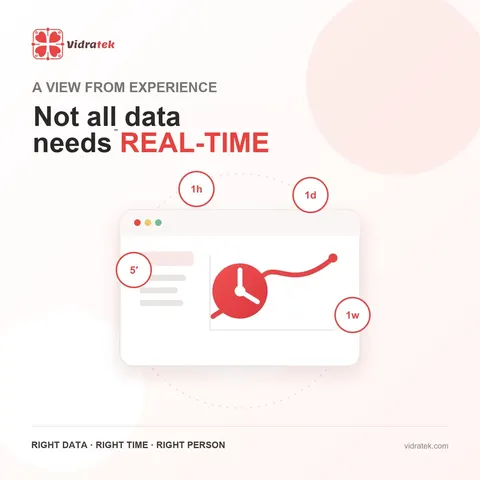
Not all data needs to be real-time. The right update frequency depends on the decision the information supports, the delay you can accept and who needs to receive it. A real-time dashboard sounds convincing: new data keeps arriving and charts change instantly. But speed doesn't always create value.
Why isn't a faster-updating report necessarily better?
Some workflows are configured to run too often. The system works correctly, but recipients start ignoring notifications because there are too many alerts. Processing costs go up, while most of the new data isn't enough to produce a different decision.
Which three questions should you answer before automating a report?
- Which decision does this information support?
- Does it matter if the update is an hour or a day later?
- Who actually needs the information, and when do they need it?
Which update frequency fits each type of data?
| Type of data | Suggested frequency |
|---|---|
| Continuously changing data (orders, inventory, transactions) | Every 5 minutes or event-driven |
| Sales reports, operational metrics | Hourly or daily |
| Executive and management reports | A summary at a fixed time, for example start of day or a set day of the week or month |
| Financial reports | Weekly or monthly |
| Special cases | Configured on each business's own schedule |
How does an AI Agent support this cycle?
An AI Agent can support the whole cycle: pulling data from authorized sources, checking for discrepancies, standardizing, consolidating, updating dashboards, analyzing changes and sending results to the right owner. But automation doesn't mean letting the system run as often as possible.
What does a good data system need to balance?
A good system runs on the right data, at the right time, for the right recipient. Only then can a business balance speed, processing cost and the real value of the information.
Frequently asked questions about report update frequency
Is a real-time dashboard always better?
No. Speed doesn't always create value, and updating too often can cause too many alerts and raise processing cost.
Which data should update every 5 minutes?
Continuously changing data such as orders, inventory or transactions can be monitored every 5 minutes or on events.
How often should financial reports update?
Usually weekly or monthly is enough.
How do I choose the right update frequency?
Answer three questions: which decision the information supports, whether a one-hour or one-day delay matters, and who needs it and when.