
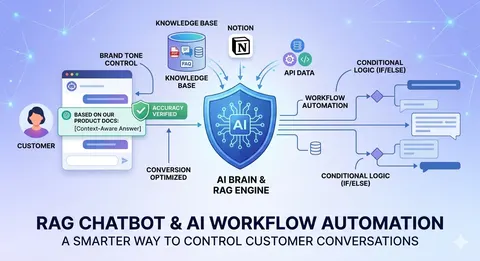
An AI chatbot gives wrong company information because ordinary AI doesn't know your business's own data. The fix is RAG (Retrieval-Augmented Generation): the chatbot looks up your document library first, then answers based on what it finds. The problem isn't that AI is bad. It's that the AI hasn't been given your data.
Why do ordinary AI chatbots give wrong answers?
Ordinary AI is trained on general data from across the internet. When customers ask about your products, policies or processes, it has no information, so it guesses, and it can guess wrong. Four problems come up again and again:
- Uncertain answers: information missing from the training data gets invented by the AI.
- Off-brand tone: there is no way to control tone, so every answer has a different style.
- Outdated information: prices and policies change, but the chatbot doesn't know to update.
- Hard to scale: adding a new scenario means starting over.
What is RAG? A simple explanation
RAG (Retrieval-Augmented Generation) is a technique that lets a chatbot look up your business's documents before it answers. Picture a new employee: before answering a customer, they quickly check the internal documentation and only then respond. A RAG chatbot works the same way.
Instead of guessing, a RAG chatbot searches your document library (FAQs, price lists, policies), pulls out exactly the information it needs, and answers based on that.
What can Vidratek's RAG chatbot system do?
- Connect your documents: PDFs, Word files, websites and databases. The chatbot learns from these sources.
- Choose the tone: you decide whether the chatbot is polite, friendly or sales-focused.
- Set up scenarios: define when the chatbot handles things on its own and when it hands over to a human.
- Answer from real data: responses follow the connected documents instead of guesswork.
- Update easily: when documents change, the chatbot picks up the new information without a rebuild.
Which businesses are a good fit for a RAG chatbot?
- Online shops: product advice, order lookup and automated handling of shipping questions.
- Software companies: technical support based on user documentation and onboarding for new customers.
- Services and consulting: answering domain-specific questions and filtering inquiries before they reach a consultant.
Where should a business start with a RAG chatbot?
Start with the group of customer questions that comes up most often. Gather accurate, current documents for that group, decide the tone you want, and set the rule for when the chatbot must hand over to a person. Once the first group runs well, expand to other topics.
Frequently asked questions about AI chatbots and RAG
What is a RAG chatbot?
It is an AI chatbot that looks up a business's documents before answering, so its replies are based on real data instead of guesses.
Why do ordinary AI chatbots make things up?
They are trained on general data and have no information about your business. When they don't know, they guess.
How is RAG different from an ordinary AI chatbot?
An ordinary chatbot answers from pre-trained knowledge. A RAG chatbot searches your documents first and then generates the answer.
What data sources can a RAG chatbot use?
PDF documents, Word files, websites and a business's databases.
Does a RAG chatbot update when prices or policies change?
Yes. When the documents are updated, the chatbot retrieves the new information without being rebuilt from scratch.