

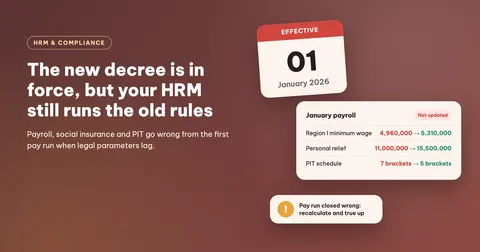
A decree on wages, social insurance or personal income tax (PIT) is in force, but the HRM system still runs on the old figures. Any pay run in that gap can use the wrong minimum wage, the wrong insurance contributions and the wrong tax withholding. Once someone notices, the business has to recalculate several pay runs, pay arrears, make up insurance contributions and explain the changes to each employee.
In 2025 and 2026 alone, payroll parameters in Vietnam changed several times: the 2024 Social Insurance Law, new regional minimum wages, new family relief amounts and a PIT schedule cut to 5 brackets. Below are six common problems when HRM falls behind, why it happens, and how to design a system where each change is entered once.
Why do wage and HR rules change so often?
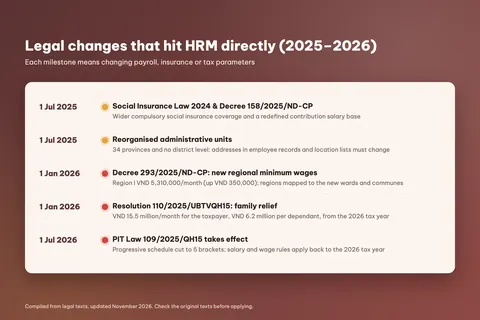
Wages, insurance and tax follow economic policy, so they are adjusted regularly. Recent milestones HR teams in Vietnam have had to handle:
- From 1 July 2025, the 2024 Social Insurance Law and Decree 158/2025/ND-CP widened compulsory coverage and redefined the contribution salary base.
- Also from 1 July 2025, the administrative reorganisation left 34 provinces and cities and removed the district level, so addresses in employee records and location lists had to change.
- From 1 January 2026, Decree 293/2025/ND-CP raised the Region I minimum wage from VND 4,960,000 to VND 5,310,000 per month; Regions II, III and IV are VND 4,730,000, 4,140,000 and 3,700,000. Regions are now mapped to the new wards and communes.
- From the 2026 tax year, Resolution 110/2025/UBTVQH15 set relief at VND 15.5 million per month for the taxpayer and VND 6.2 million for each dependant (previously VND 11 million and 4.4 million).
- From 1 July 2026, PIT Law 109/2025/QH15 cuts the progressive schedule from 7 brackets to 5. Its rules on residents’ salary and wage income apply from the 2026 tax year.
Each text usually brings circulars, guidance letters and new forms, sometimes issued after the effective date. For HR, each milestone is another round of parameter changes in the system.
Six problems when HRM falls behind new decrees
1. Pay drops below the regional minimum wage and nobody notices
When the minimum wage rises, roles paid close to the old level fall below the new one on the effective date. If HRM does not check against the new figure, payroll runs as usual and the error surfaces only when an employee asks or an inspector does.
2. Wrong social insurance contributions, then arrears with interest
The salary used for social insurance cannot be lower than the regional minimum wage, and the cap follows the reference level. With old parameters, both employer and employee contributions are off. The shortfall has to be paid, possibly with late-payment interest, and the records on the social insurance portal corrected.
3. Wrong PIT withholding and a messy year-end
Family relief and the tax schedule set how much tax is withheld each month. A system still on VND 11 million and 7 brackets over-withholds for most staff. The excess can be settled at year-end, but until then people take home less for months and accounting has to reconcile everything again.
4. Retroactive rules mean recalculating several periods
Some rules reach back in time. The 2025 PIT Law takes effect on 1 July 2026, yet its salary and wage rules cover the whole 2026 tax year. If the system cannot recalculate past periods, HR reworks each person and each period by hand.
5. Outdated lists and forms after the reorganisation
Regional minimum wages now follow the new wards and communes. If the HRM location list still uses the old provinces and districts, it can put a branch in the wrong region, which means the wrong minimum wage and the wrong address on contracts, decisions and reports to the authorities.
6. HR goes back to Excel and the data splits
While waiting for an update, HR often calculates in Excel and keys the results in by hand. The data now lives in two places, is hard to audit, depends on whoever owns the file and breaks at every handover. Employees start to doubt their payslips too.
Why are many HRM systems slow to update?
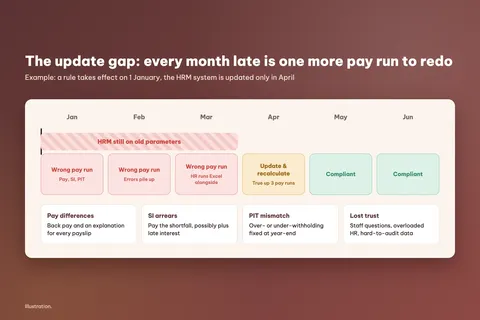
Five causes come up again and again. First, minimum wages, contribution rates and tax schedules are written into the formulas, so each change means editing code, testing and shipping a release. Second, nothing is stored by effective date: a new value overwrites the old one, so earlier periods cannot be recalculated or explained.
Third, on-premise installations wait their turn for vendor upgrades, sometimes for several pay runs. Fourth, master data such as locations, wage regions, contract types and forms is locked, so the business cannot change it. Finally, nobody is assigned to watch for new texts, so news arrives late through the press or the social insurance office, after payroll has closed.
| Criteria | HRM that lags | HRM that keeps up |
|---|---|---|
| Parameter storage | Hard-coded, old values overwritten | Parameter table with effective dates and legal basis |
| When a new text is issued | Wait for the vendor's next release | Add a new parameter row effective from the right date |
| Retroactive rules | HR reworks each person and period by hand | Recalculate closed periods and generate true-up entries |
| Before applying | No idea who is affected | Simulate the impact on pay, insurance and tax |
| Audit | Figures scattered between HRM and Excel | Full change log in one system |
How should an HRM system be designed to keep up with new decrees?
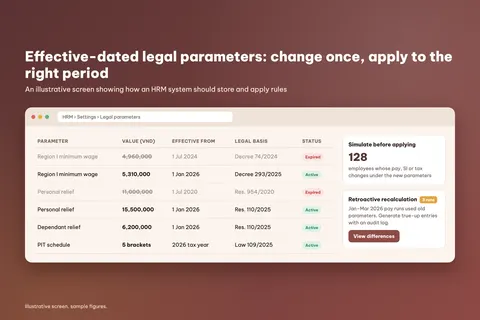
Start by taking every rule out of the code. Regional minimum wages, the reference level, social, health and unemployment insurance rates, trade union fees, relief amounts and tax schedules should all be configuration data. Each value gets a start date, an end date and the number of the legal text behind it, so every pay run picks up the values for its own period.
On top of that, the system needs a few functions:
- A trial payroll with the new parameters before they go live, showing who is affected and by how much.
- Retroactive recalculation of closed periods when a rule reaches back, with arrears and true-up entries created automatically and the reason recorded.
- A separate location list, with wage regions tied to the ward or commune of each branch and editable when boundaries change.
- Reminders before upcoming effective dates, and a list of employees paid close to the new minimum.
On a SaaS platform, the vendor updates the parameter table once for every customer and the business only reviews and confirms. If you run several systems, connecting ERP, CRM and HRM into one source of figures lets payroll, insurance, tax and accounting work from the same numbers after each change.
A checklist for HR when a new decree is issued
- Find out when the text applies, to which pay period or tax year, and whether it is retroactive.
- List the parameters it touches: minimum wage, insurance contributions, relief, tax schedule, location list, forms.
- Enter the new values before the first affected pay run, with the effective date and document number.
- Run a trial payroll, compare it with the previous period and look closely at cases near the thresholds.
- Review contracts, raise pay that falls below the new minimum and tell employees why their take-home pay changed.
- If the rule is retroactive, prepare arrears and true-up entries for closed periods and correct insurance and tax records.
The legal information here is current as of November 2026 and is for reference only. Check the original texts or ask an expert before applying it.
Frequently asked questions
If a new decree is in force but HRM has not been updated, do we have to recalculate payroll?
Yes. Pay, social insurance and tax obligations follow the rules in force, not the software version. Wrong pay runs must be recalculated, arrears paid to employees and insurance and tax records corrected.
What are Vietnam's regional minimum wages in 2026?
Under Decree 293/2025/ND-CP, from 1 January 2026 the monthly minimum wage is VND 5,310,000 (Region I), VND 4,730,000 (Region II), VND 4,140,000 (Region III) and VND 3,700,000 (Region IV). The region depends on the ward or commune where the business operates.
When does the VND 15.5 million family relief apply?
Under Resolution 110/2025/UBTVQH15, relief of VND 15.5 million per month for the taxpayer and VND 6.2 million per month for each dependant applies from the 2026 tax year. The 2025 settlement still uses the old amounts.
Why store legal parameters by effective date?
Because each pay run must follow the rules of its own period. Effective dating lets the system apply new values from the right date, still recalculate older periods and provide evidence for audits.
Does a SaaS HRM keep up with regulations faster?
Usually, because the vendor updates the parameter table once for all customers instead of upgrading each installation. The business should still review the values and run a simulation before the first affected pay run.