
A CRM, HR software or a Zalo OA integration usually gets the whole leadership team’s agreement that it is needed, and then slips to next quarter every year. Everyone sees the value; what holds them back is the amount of effort that comes with it.
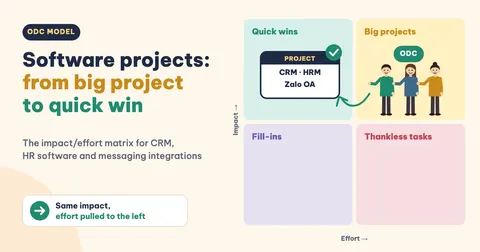
The impact/effort matrix explains this well and suggests a way out: keep the project’s value as it is and cut the share of effort your company carries itself. The ODC (Offshore Development Center, a dedicated development team) model does exactly that.
What is the impact/effort matrix?
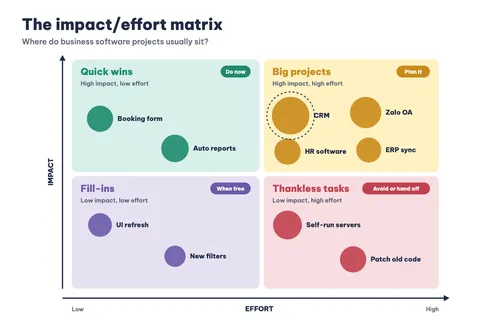
It is a simple prioritisation tool. Each piece of work is scored on impact (how much value it brings) and effort (how many people, how much time, money and management attention it takes), and lands in one of four boxes:
- Quick wins: high impact, low effort. Do them now.
- Big projects: high impact, high effort. Worth doing, but they need a plan and resources.
- Fill-ins: low impact, low effort. Do them when there is time.
- Thankless tasks: low impact, high effort. Avoid them, change how they are done, or hand them off.
Some versions of the matrix label the high-effort boxes with "delegate" or "outsource". The ODC approach starts from the same idea.
Why business software projects land in "big projects"
The value is rarely in question. A CRM stops you losing customers through missed follow-ups. HR software gets payroll and attendance right and keeps up with new regulations. A Zalo OA integration sends notifications and handles customer care automatically on the channel your customers use most.
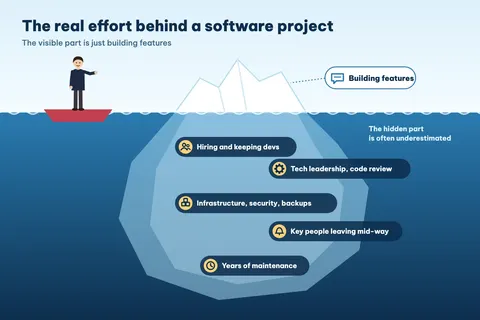
The effort is the problem. Doing it yourself means carrying everything below the waterline. You have to find, interview and keep developers in a market that is short of them, which often takes months. You need someone senior enough to split the work, review code and choose the technology, or quality is hard to control. Someone has to look after servers, test environments, backups, security and monitoring. And one key developer resigning can stall the project for weeks.
Then there is maintenance: fixes, updates and changes when regulations or connected systems change, for years after launch. It is a thankless task in the matrix’s sense: nobody notices while it works, and everyone notices when it breaks.
With HR software, for example, every new decree means another update; see 6 problems when your HR system lags behind the law.
An ODC keeps the impact and pulls the effort to the left
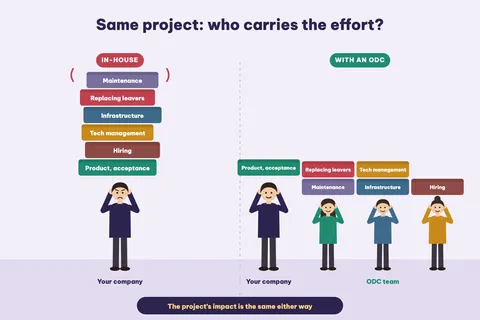
With an ODC, the CRM is still a CRM and the HR software still solves the same problem. What changes is who carries the effort. The vendor handles hiring, technical management, infrastructure, replacements and maintenance, and your company concentrates on the product and on acceptance.
On the matrix, the impact axis stays put while the effort axis (measured as what your company does itself) shifts left. The project moves out of "big projects" towards "quick wins" and can start sooner instead of sitting on the "later" list.
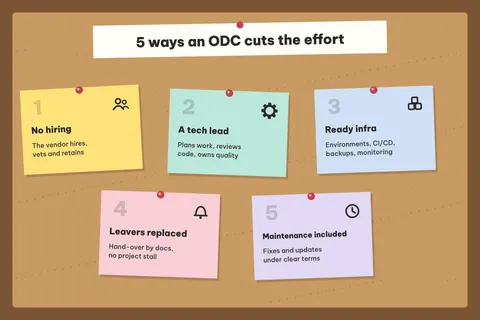
5 ways an ODC cuts the effort
- No hiring of your own. The vendor recruits, runs technical interviews and keeps staff; you approve the proposed team instead of advertising from scratch.
- A technical lead. Someone on the vendor side plans the work, reviews code and owns quality, so you do not need your own CTO to manage the team.
- Infrastructure is ready. Development and test environments, CI/CD pipelines, backups and monitoring already exist.
- People who leave are replaced under the contract, and handover runs on documentation and code, so the project keeps moving.
- Maintenance is in the contract, with a defined scope and response time, instead of a new bill every time something breaks.
| Area | In-house | With an ODC |
|---|---|---|
| Hiring and retention | Your company | Vendor |
| Technical management, code review | Your company (needs a CTO or lead) | Vendor’s tech lead |
| Dev infrastructure, CI/CD | Built by your company | Already in place |
| Replacing people who leave | Your company re-hires | Vendor replaces under contract |
| Maintenance after launch | Your company | Per contract scope |
| Product direction, priorities | Your company | Your company |
| Acceptance | Your company | Your company |
What your company still does with an ODC
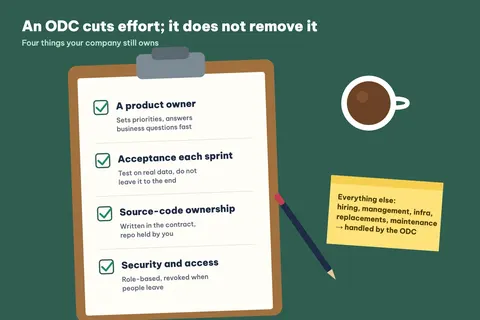
Hiring an ODC does not mean your company sits back and waits. You keep four jobs, and how well you do them decides whether the project succeeds.
- A product owner on your side sets priorities and answers business questions quickly. Without one, the team has to guess.
- Accept the work after every sprint, against real data and processes, instead of saving it all for the end.
- The contract states who owns the code, and your company holds admin rights to the repository.
- Access is granted by role, covered by a confidentiality agreement, and revoked when people leave the project.
The clauses an ODC contract should include are listed in Running an in-house IT team: 7 people risks and how an ODC model takes them on.
Score your own project on the matrix
- Score impact from 1 to 5: how much the project grows revenue, cuts cost, reduces compliance risk or improves customer experience.
- Score effort by component rather than as one number: hiring, technical management, infrastructure, people risk, maintenance and feature building.
- Re-score effort with an ODC: drop what the vendor carries and keep only what you still do (product ownership, acceptance, contract management).
- Compare the two positions. If the project moves from "big projects" towards "quick wins", it is worth starting now.
Vidratek builds custom software and system integrations such as CRM, HRM and Zalo OA with dedicated teams, plus maintenance and support after launch.
Frequently asked questions
What is the impact/effort matrix used for?
To prioritise tasks or projects by two criteria: the value they bring and the effort they take. It shows what to do now, what needs a plan, and what to avoid or hand off.
How is an ODC different from a fixed-price project?
A fixed-price project usually locks scope and price up front and is hard to change mid-way. An ODC is a dedicated team working continuously for you, with priorities adjustable each sprint, which suits products that need ongoing development and maintenance.
Can a company without technical staff use an ODC?
Yes. The vendor’s tech lead covers the technical side. You need a product owner who understands the business to set priorities and accept work; they do not need to code.
Who owns the source code with an ODC?
The contract should state that the code belongs to your company and that you hold admin rights to the repository. Check this clause before signing.
Is an ODC worth it for a small project?
If the project is one-off with little long-term maintenance, a project-based contract may fit better. An ODC pays off when the software needs continued development, regulatory updates or new integrations over several years.