
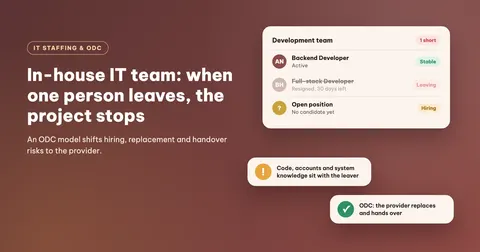
With an in-house IT team, every people risk is yours: roles that take months to fill, people who resign mid-project, system knowledge held by one or two developers, and access you grant and revoke by hand each time someone joins or leaves. In an ODC (Offshore/Offsite Development Center) model, the provider hires, manages, replaces and handles handover, while the business keeps product direction and priorities.
Below are seven common problems of running your own IT team in Vietnam, which of them an ODC takes on, and what to ask for when choosing a provider.
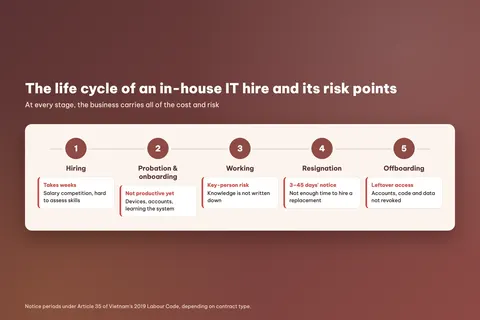
Seven problems of running an in-house IT team
1. Hiring is slow and hard to get right
Good developers have options, so you compete on pay, benefits and culture. Without someone technical in the interview, it is hard to tell a strong candidate from a good talker. A role can stay open for weeks while the project still has deadlines.
2. A resignation stalls the project
Under Article 35 of Vietnam’s 2019 Labour Code, employees give 3 to 45 days’ notice depending on the contract. That is rarely enough to hire, onboard and hand over. Usually the half-built feature stops, or goes to someone who does not know the system yet.
3. A few people hold everything
In a small team, the architecture, deployment steps and operational tricks often live in one or two heads. When those people take long leave or resign, you lose the ability to fix issues quickly and keep building.
4. Joiners, leavers and access
Each new joiner needs a laptop, email, repository, server, database and tool accounts. Each leaver needs all of them revoked. One forgotten admin account or server key is enough to expose data and source code.
5. The real cost is higher than the salary
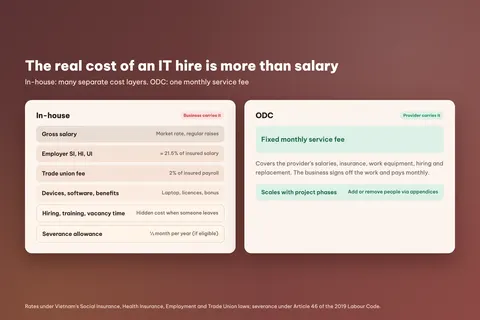
On top of salary, employers in Vietnam pay around 21.5% for social, health and unemployment insurance and a 2% trade union fee on the insured payroll. Add equipment, software licences, bonuses, training, hiring costs and severance (half a month’s pay per year worked, where Article 46 applies). The weeks between one person leaving and the next starting cost money too; they are just harder to measure.
6. Technical quality is hard to judge
Many businesses have no CTO or tech lead, so nobody can say whether the code is sound, the estimates fair or the system secure. Problems tend to show up only when the system slows down, breaks often or cannot scale.
7. Scaling up or down is slow
Some phases need extra people to hit a launch date; others need only maintenance. In-house, growing means hiring, and shrinking runs into employment contracts and company culture.
What is the ODC model?
ODC (Offshore or Offsite Development Center) is a way to engage a dedicated software development team from a provider. The team works full time on your project, following your plans and priorities, but stays on the provider’s payroll.
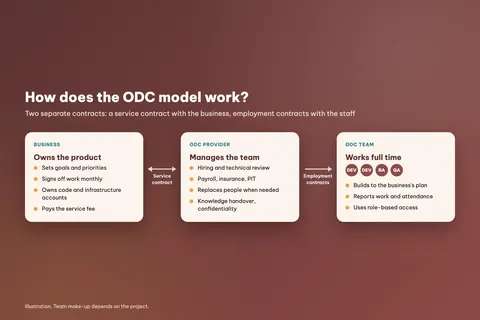
The provider signs the employment contracts, pays salaries and insurance, manages the people and replaces anyone who leaves. You sign a service contract, sign off the work and pay monthly.
ODC is often confused with labour leasing, but the two differ. Under the 2019 Labour Code, labour leasing is a conditional business line that needs a licence, covers only certain jobs and is capped at 12 months. In an ODC, the provider sells software development services and manages its own team, so the contract should spell out the scope, how work is signed off and what each side is responsible for.
How does ODC reduce people risk?
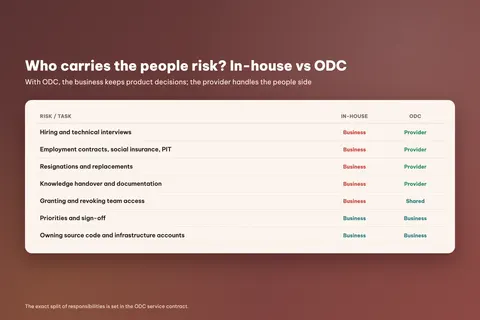
Hiring and technical interviews move to the provider, which already has the process and the reviewers; you approve the team’s profiles. When someone leaves, the contract sets how quickly the provider must bring in someone with equivalent skills, at its own cost. The provider also documents the work and hands over internally, so knowledge does not walk out with one person.
For access, the provider handles onboarding, offboarding and confidentiality commitments for its people, while you keep infrastructure accounts in your own name and grant access by role. Employment contracts, insurance and tax sit with the provider, so you have no employment obligations to individual team members. To grow or shrink the team between project phases, you sign a contract appendix.
| Criteria | In-house IT team | ODC team |
|---|---|---|
| Time to a working team | Depends on hiring each role | Provider assigns from an existing pool |
| When someone leaves | Business hires and hands over | Provider replaces with equivalent skills and handles handover |
| Cost | Salary, insurance, equipment, hiring, hidden costs | Fixed monthly service fee |
| Employment obligations | Business | Provider |
| Priorities and sign-off | Business | Business |
| Scaling up or down | Slow, tied to employment contracts | Adjusted through contract appendices |
When should you still build an in-house team?
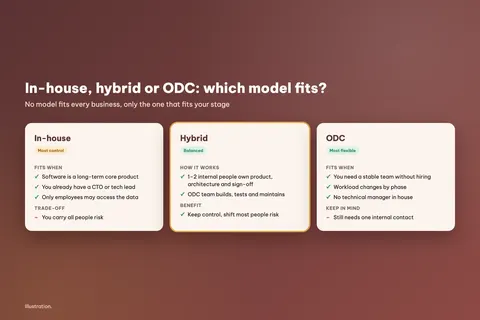
Some cases still call for internal staff: the software is a long-term core product, you need people who know the business and its culture deeply, or regulations allow only employees to access certain data.
Many businesses use a hybrid. One or two internal people own the product, architecture and sign-off, and an ODC team handles development, testing and maintenance. Control stays in-house while most of the people risk moves to the provider.
A checklist for choosing an ODC provider
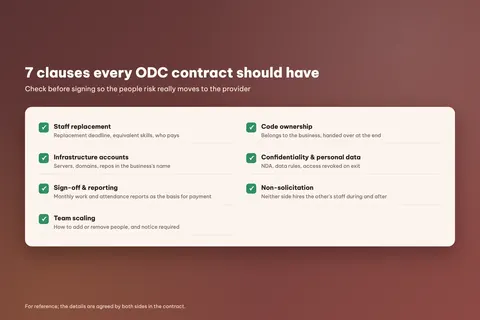
- Replacement: how fast people are replaced, what "equivalent skills" means, and who pays.
- Code and work results belong to your business, with an obligation to hand over code and documentation at the end.
- Servers, domains and repositories are in your name, and you grant access.
- An NDA, personal data processing rules, and how access is revoked when someone leaves the project.
- Monthly work and attendance reports, and a clear sign-off process as the basis for payment.
- Non-solicitation: neither side hires the other’s people during or after the contract.
- How to add or remove people, and how much notice is needed.
The legal information here is current as of November 2026 and is for reference only. Check the original texts or ask an expert before applying it.
Learn more about Vidratek's software development services, including dedicated development teams on a monthly basis.
Frequently asked questions
What is ODC?
ODC (Offshore or Offsite Development Center) is a model where a business engages a dedicated software development team from a provider. The team works full time on the business's project, while the provider manages the people, employment contracts and replacements.
How is ODC different from labour leasing?
In Vietnam, labour leasing is a conditional business line that needs a licence, is limited to certain jobs and is capped at 12 months. In ODC, the provider delivers software development services and manages its own team under a service contract.
Who owns the source code with ODC?
Usually the business owns the source code and work results. This should be written into the contract, together with an obligation to hand over code and documentation when the engagement ends.
What happens if an ODC team member resigns?
The provider replaces them with someone of equivalent skills within the period set in the contract, at its own cost, and handles the handover so progress is not affected.
Is ODC a good fit for small businesses?
ODC suits businesses that need a stable development team but do not want to hire and manage IT staff themselves. You should still have one internal contact to set priorities and sign off the work.